
Session Duration: 2 hours
Format: Group work, worksheets (Quadruple Helix mapping), case study review
Building strong, multidisciplinary partnerships and diversifying funding sources are essential for sustainable research and innovation ecosystems. The ATPS Grantsmanship and Funding Curriculum offers strategic approaches to help institutions achieve these goals. Below is a structured section for building strategic partnerships and funding diversification:
1. Understanding Strategic Partnerships: Research has shown that proposals involving multiple helix partners are 60% more likely to receive funding because they demonstrate broader impact potential. A strategic partnership requires collaboration with stakeholders whose missions align with your research objectives. The ATPS curriculum introduces the Quadruple Helix Model, emphasizing four sectors as presented in Figure 1 below:
a) Government: policy development and governance
b) Academia: research and teaching
c) Industry: innovation and commercial value
d) Civil Society/NGOs: advocacy, service delivery, and societal impact
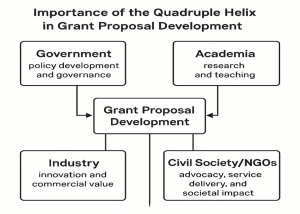
Figure 1: The Quadruple Helix Model
Action Point for Trainees: Map out specific potential partners in each quadrant based on your research theme.
2. Building Effective Partnerships: In building effective partnerships, the proposal should:
a) Identify Shared Goals: Partners should have overlapping interests in solving a national or regional problem.
b) Use Data to Drive Collaboration: Present evidence of the issue and its alignment with national development plans or UN Sustainable Development Goals (SDGs).
c) Clarify Roles: Define contributions, responsibilities, and benefits for each partner in terms of knowledge, resources, or influence.
3. Targeting Regional and International Partners: Use the Regional Economic Communities (RECs) and international networks as platforms to build cross-border collaborations. Key RECs include:
a) ECOWAS (West Africa)
b) EAC, SADC, COMESA (other African blocs)
c) IGAD, ECCAS, UMA, CEN-SAD (continental partners)
Also consider international funders and agencies, such as:
a) Bill & Melinda Gates Foundation
b) Global Environment Facility
c) European Commission (EuropeAid)
d) FAO, AusAID, DFID, and others.
📈 Tip: Leverage existing Memoranda of Understanding (MoUs) and joint calls for proposals under these platforms.
Case Studies for Discussion
Senegal: The Senegalese National Research Fund partnered with the French Development Agency (AFD) to co-fund projects in renewable energy, showing how local councils can leverage bilateral partnerships.
4. Diversifying Funding Sources: Diversification involves seeking funds from a variety of streams, including:
| Funding Type | Examples |
| Bilateral Donors | IDRC, USAID, GIZ, DFID, NORAD |
| Multilateral Agencies | World Bank, AfDB, UNDP, GEF |
| Private Foundations | Rockefeller, Ford, Carnegie, Mastercard |
| Corporate CSR Funds | DuPont, Carrefour, multinational agri-tech or pharma firms |
| Academic Consortia | Global Challenge Research Fund (UKRI), Horizon Europe |
| Local Governments | State research innovation grants |
| Diaspora Networks | Professional and alumni associations with research funding arms |
Best Practice: Maintain a centralized database of all potential and previous funders, their themes, application windows, and contacts.
Group Exercise: Each group should form a “MONEY Crew” and role-play outreach to a potential partner. Each crew should be composed of a team of vibrant members, with each member focusing on different aspects of partnership and funding as follows:
a) The Coordinating Person: leads planning and implementation
b) The Source Person: scouts for opportunities and partnerships
c) The Liaison Person: manages communications and engagement
d) The Proposal Person: develops grant proposals
e) The Finance Person: oversees budgeting and compliance
Below is a sample strategic worksheet to be used by each MONEY Crew. Map potential partners in your ecosystem using the Quadruple Helix framework, identifying at least one potential collaborator from academia, industry, government, and civil society. Follow the key steps to develop your Group’s strategic partnership using the Worksheet below:
| Worksheet: Strategic Partnership & Funding Diversification Mapping | ||||||||||||||||||||||||
| Objective: To identify and document potential partners and funding sources aligned with your research or innovation project, using the Quadruple Helix and funding typology approaches. Section 1: Define Your Focus Area What problem are you solving? (Summarize in one sentence) Which SDGs does it align with? (Tick all that apply): ☐ No Poverty ☐ Quality Education ☐ Climate Action ☐ Gender Equality ☐ Clean Water ☐ Affordable Energy ☐ Industry, Innovation and Infrastructure ☐ Others: _________________________________ Section 2: Strategic Partnership Mapping (Quadruple Helix)
💡 Tip: Consider local universities, ministries, private sector innovators, NGOs, and advocacy groups. Section 3: Funding Source Identification
|
6. Building a Strategic Partnerships Plan (30 minutes): Case Study: Kenya’s National Research Fund transformed its success rate by implementing a partnerships strategy with three components: 1) An annual ‘Research Matchmaking’ event bringing together all four helix partners, 2) A database of potential collaborators categorized by expertise, and 3) Partnership training for researchers.
Group Activity: In your groups, draft a one-page partnerships strategy for your organization, including:
a) Top three strategic partner types to cultivate
b) Methods for partnership development
c) Criteria for evaluating potential partners
d) Mechanisms for sustaining partnerships beyond single projects
7. Promoting Your Work to Attract Partners and Funders: Use professional social media such as LinkedIn to promote your projects, tag partners, and highlight milestones. Also, ensure impact promotion by regularly publishing your research outputs, success stories, and community benefits. Use forums, such as attendance at and organization of workshops, to build trust and co-develop proposals with new stakeholders.
8. Institutionalizing Partnership and Fundraising Strategies: Develop a Partnership Engagement Policy that outlines criteria, processes, and expected outcomes for collaboration. Create a funding strategy document that identifies annual priorities, targets, and pipelines. Establish a grants office or a resource mobilization unit within the council to ensure long-term sustainability.
Facilitators Notes
a) Demonstrate the Quadruple Helix Model using a mapping exercise.
b) Facilitate partner identification brainstorming in groups.
c) Showcase regional case studies (e.g., Senegal-AFD renewable energy).
d) Highlight diversification beyond traditional donors.
Suggestions for Further Reading
a) Carayannis, E., & Campbell, D. (2012). Mode 3 Knowledge Production in Quadruple Helix Innovation Systems. Springer.
b) OECD (2019). Mobilising Funding for Development Research. Paris: OECD Publishing.
c) Global Research Council (2021). Annual Report on Multilateral Collaboration in Research.